
Remembering the Shikoku pilgrimage, I realized the teaching had been there all along.

In my thirties, I once walked the Shikoku pilgrimage. It started as a way to pray for my younger brother, who had died.
On my own two feet, I traced the path Kūkai is said to have opened, making my way around all 88 sacred temples. Whether I was searching for something or just wanted to try it — back then, I couldn't have told you myself.。
Somewhere along the walk, honestly, I stopped thinking much about my brother.
Before that, I'd been eaten up with regret, sure I could have saved him. And — it's embarrassing to admit now — even though there was nothing criminal about it, I went looking for someone to blame.
But little by little I saw it: I just didn't want to admit I was the older brother who couldn't save his younger one. And I accepted that self, the one who could do nothing.
My brother had seen through me the whole time. It was as if he said, "So you finally get it." After that, strangely, I thought about him less and less.
Because I walked it in segments, it was as if I lived two realities at once — everyday life and the pilgrimage. A feeling rose up in me: the me who was walking was the real me, and there was another me who went to work so that the walking could happen.
I have no answer here, but the people and events in daily life started to feel like they weren't real. And I just walked. I just kept walking the pilgrimage.
Before I set out, the Heart Sutra — the Hannya Shingyō — was something I couldn't even chant; I couldn't catch my breath. Then, out of nowhere, it flowed out of me. At first I walked in casual clothes, but bit by bit it changed: I took up the staff, put on the white robe, wore the kesa, held the prayer beads — until I had become a henro, completely.
Golden Week, summer holidays, New Year's — using each break, it took five years. When I completed all 88, it was very quiet. Of course, no one was waiting, so nothing dramatic happened.
But as time passed, a sense of "I did it" seeped in, drop by drop. That was all. Yet it was the first sense of accomplishment I'd felt in over thirty years of living, and I remember how full my heart was.
Whether or not you've had an experience that gives you that feeling changes the depth of your heart completely. That much I can say for certain. Later, as I read a number of books and searched for words of my own, I realized: the words I'd arrived at already had names, long ago.
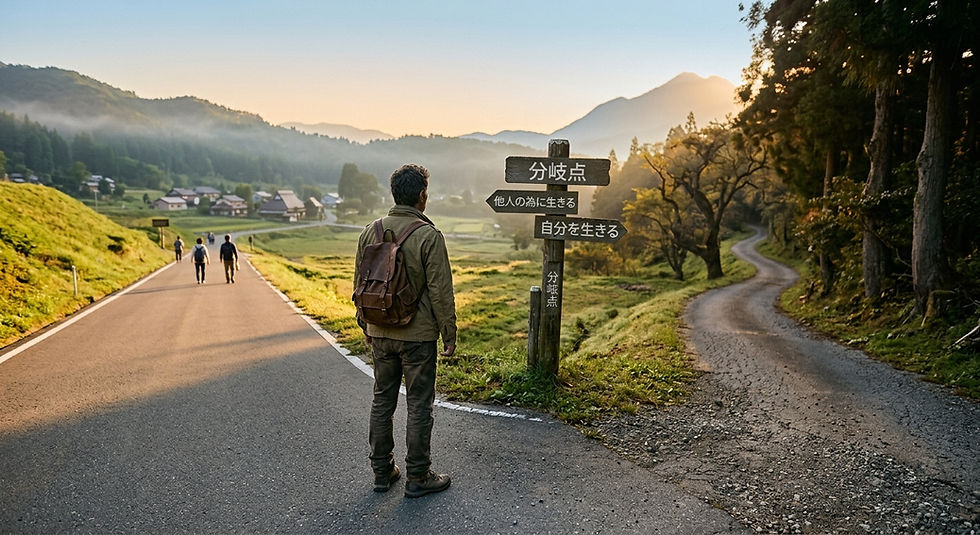
When I tried to sort out what I meant by "becoming it fully," Kūkai's phrase "sokushin jōbutsu" — attaining Buddhahood in this very body — snagged on me. It sounds difficult, but the meaning is simple. Not aiming at some distant ideal, but living now as the self you already are. Not "I want to become—" but intending, "This is how I live." It's the same thing as the "becoming it fully" I've been writing on the blog all along. When I walked the pilgrim's road, I wasn't "aiming" at anything. I was simply there, as a pilgrim. Looking back, that was the closest I've come to "becoming it fully."
Something close to "feeling it fully" was in esoteric Buddhism too. As the Rishukyō puts it, you don't put a lid on the emotions that rise up — you take them in as your true self. It's very close to what I'd been calling "feeling it fully."
And introspection on its own just circles in your head. While you turn it over and over, you get to feel like you "understand." But what actually comes into view comes after you put it into words. Writing it, speaking it, expressing it and passing it to someone else. Only when you take the action of output does introspection become "realization." Introspection and conveying it don't work unless they come as a set. And that, too, is part of "acting."
Kūkai lived 1,200 years ago. Esoteric Buddhism is an old system of thought handed down from ancient India. The era and the culture are completely different, and yet what they say overlaps. The words I'd wrung out of my own experience already had teachings behind them. Knowing that, for some reason, made me feel a little lighter.
The pilgrimage I walked to pray for my brother. When I came to know the self who could do nothing, strangely, I thought about it less.
"Becoming it fully" connects to sokushin jōbutsu, and "feeling it fully" to the teaching of the Rishukyō. Words I thought I'd wrung out myself already had teachings behind them.
Introspection and action don't work unless they're a set. Only by conveying it does what you've reflected on truly come into view.


Comments